
SALIVARY GLAND CARCINOMA: A PEDIATRIC CASE
Salivary gland secretory carcinoma (SC) represents a rare, slow-growing, low-grade malignant neoplasm that occurs mainly in the parotid gland. It has a slight predilection for the male gender and usually appears in adulthood. The morphologic and immunohistochemical features are like those observed in secretory breast carcinoma; however, it has been described as a distinct salivary gland tumor. Its clinical characteristics remain nonspecific and therefore can be misdiagnosed. The report ⬇️ describes a 12-year-old patient who presented with a slow, progressive, painless, and deforming mass at the level of the left lower third of the face, of eight months’ evolution. After clinical and imaging evaluation, an excisional biopsy was performed. The sample was sent for histopathological study, which reported salivary gland SC. Although this condition typically presents in adults, it can occur in children, and it is important to consider it among the neoplasms that can occur at this age.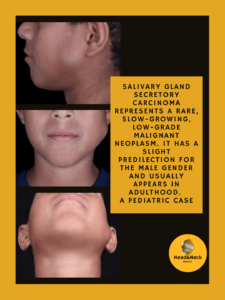
Case Presentation
A 12-year-old male patient was referred to the Department of Oral and Maxillofacial Surgery of the Hospital General del Oeste “Dr. José Gregorio Hernández,” Caracas, Venezuela, with an extraoral normochromic and normothermic painless mass with slow growth on the left parotid-masseteric region evolving over eight months. It was mobile and soft to palpation (…)
SC is an infrequent malignant neoplasm of the salivary glands that does not commonly affect children. Although rare, it can occur and mimic benign lesions due to its behavior and clinical characteristics. There are few reports of SC in the pediatric age, but many agree that the clinical course is indolent, which can lead to misdiagnosis. Clinicians should be aware of this possibility and include this diagnosis when encountering a pediatric patient.