
CANCER IS AN ANCIENT FOE
Cancer is an ancient foe, not the modern malady it’s often portrayed as.
In 2016, a 1.7 million year old osteosarcoma was reported by Dr Edward John Odes (a doctoral student in Anatomical Sciences from the University of the Witwatersrand Medical School, South Africa) and colleagues, representing the oldest documented malignant hominin cancer. 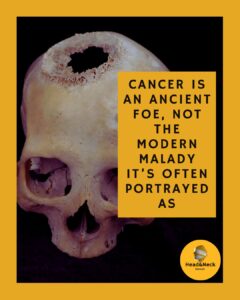
The earliest known descriptions of cancer appear in several papyri from ancient Egypt. The Edwin Smith Papyrus was written around 1600 BC, and contains a description of cancer, as well as a procedure to remove breast tumours by cauterization, stating that the disease has no treatment. However, incidents of cancer were rare, because age is the highest risk factor and life expectancy was not more than 40 years. In a study by the University of Manchester, only one case was found “in the investigation of hundreds of Egyptian mummies, with few references to cancer in literary evidence.”
Lesions in Skull E270, in the Duckworth Laboratory collection at the University of Cambridge, have long been heralded as some of the earliest evidence for cancer in humans. Scientists believe the bony indentations in the 4000-year-old-skull from ancient Egypt were made by malignant tumors. A study released in Frontiers in Medicine suggests someone tried to cut it out. Looking at the skull under a microscope, and assisted by micro-CT scans, scientists say they have found cut marks around the lesions indicative of surgical tumor removal. It’s impossible to determine whether the cuts were made before or after the 30- to 35-year-old man’s death, the authors note. But either way, they indicate either the surgical study or treatment of cancer.
Source: Wikipedia and New York Times